


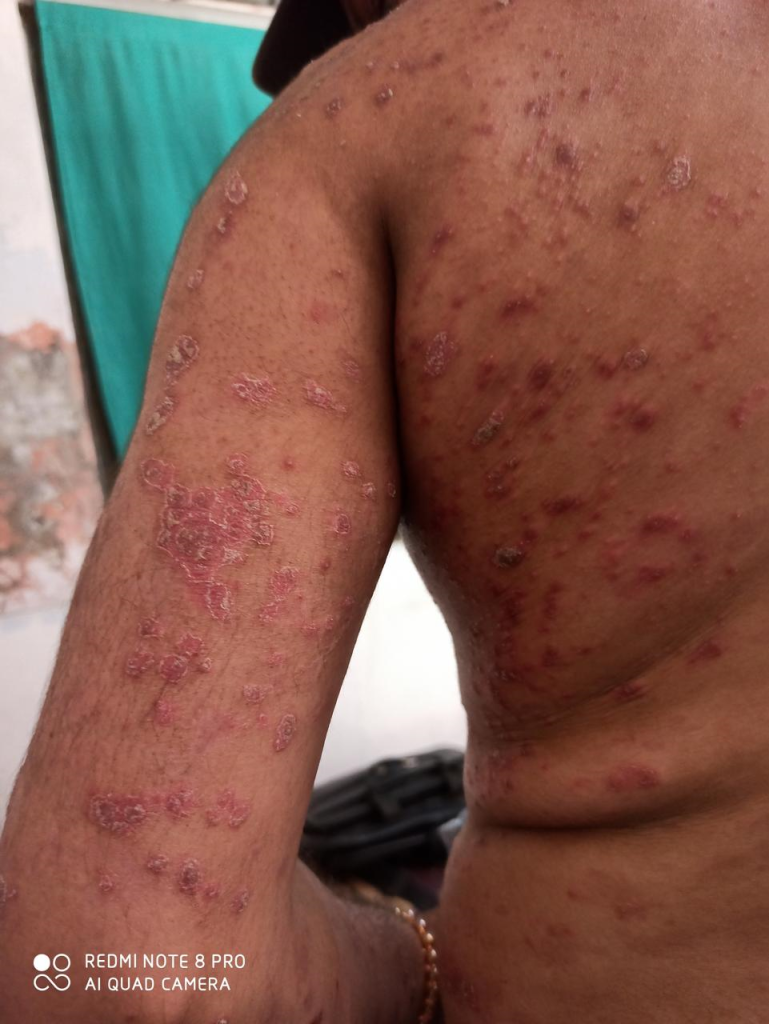
Psoriasis is a chronic, autoimmune skin condition that causes rapid skin cell turnover, leading to thick, scaly patches on the skin. Below is a detailed overview, especially in light of your previous questions about leucoderma and ringworm, to clarify distinctions and provide comprehensive information.
What is Psoriasis?
- Definition: Psoriasis is a non-contagious, inflammatory condition where the immune system triggers excessive skin cell production, resulting in red, scaly, and sometimes itchy or painful patches (plaques).
- Appearance: Thick, red patches covered with silvery-white scales. Patches vary in size and may appear anywhere but commonly affect elbows, knees, scalp, lower back, and nails.
- Types:
- Plaque Psoriasis (most common): Raised, red patches with silvery scales.
- Guttate Psoriasis: Small, dot-like lesions, often triggered by infections like strep throat.
- Inverse Psoriasis: Smooth, red patches in skin folds (e.g., armpits, groin).
- Pustular Psoriasis: White, pus-filled blisters surrounded by red skin.
- Erythrodermic Psoriasis: Widespread redness and scaling, rare but severe.
- Psoriatic Arthritis: Psoriasis with joint inflammation, causing pain and stiffness.
Causes
- Autoimmune: The immune system mistakenly attacks healthy skin cells, accelerating their growth cycle (from 28–30 days to 3–4 days).
- Genetic Factors: Family history increases risk; specific genes (e.g., HLA-Cw6) are linked.
- Triggers:
- Stress, infections (e.g., strep throat), or skin injuries (cuts, burns, known as the Koebner phenomenon).
- Cold, dry weather or excessive sun exposure.
- Medications (e.g., beta-blockers, lithium) or alcohol/smoking.
- Hormonal changes or immune system disorders.
Symptoms
- Red, raised patches with silvery-white scales.
- Itching, burning, or soreness in affected areas.
- Dry, cracked skin that may bleed.
- Nail changes: Pitting, thickening, or separation from the nail bed.
- Joint pain or swelling (in psoriatic arthritis).
- Symptoms vary in severity, with flare-ups alternating with periods of remission.
Diagnosis
- Clinical Examination: A dermatologist assesses the appearance of skin, nails, and scalp. The presence of scaly plaques is often diagnostic.
- Medical History: To identify triggers, family history, or associated conditions.
- Skin Biopsy: Rarely needed but confirms psoriasis by showing thickened skin and immune cell infiltration.
- Differential Diagnosis: Must be distinguished from:
- Leucoderma/Vitiligo: White, non-scaly patches without inflammation.
- Ringworm: Red, ring-shaped, scaly patches caused by fungi, often itchier and treatable with antifungals.
- Eczema: Itchy, red, less scaly patches, often in skin folds.

